
Skills in 2026: What 10 Years Taught Us About Building Capability
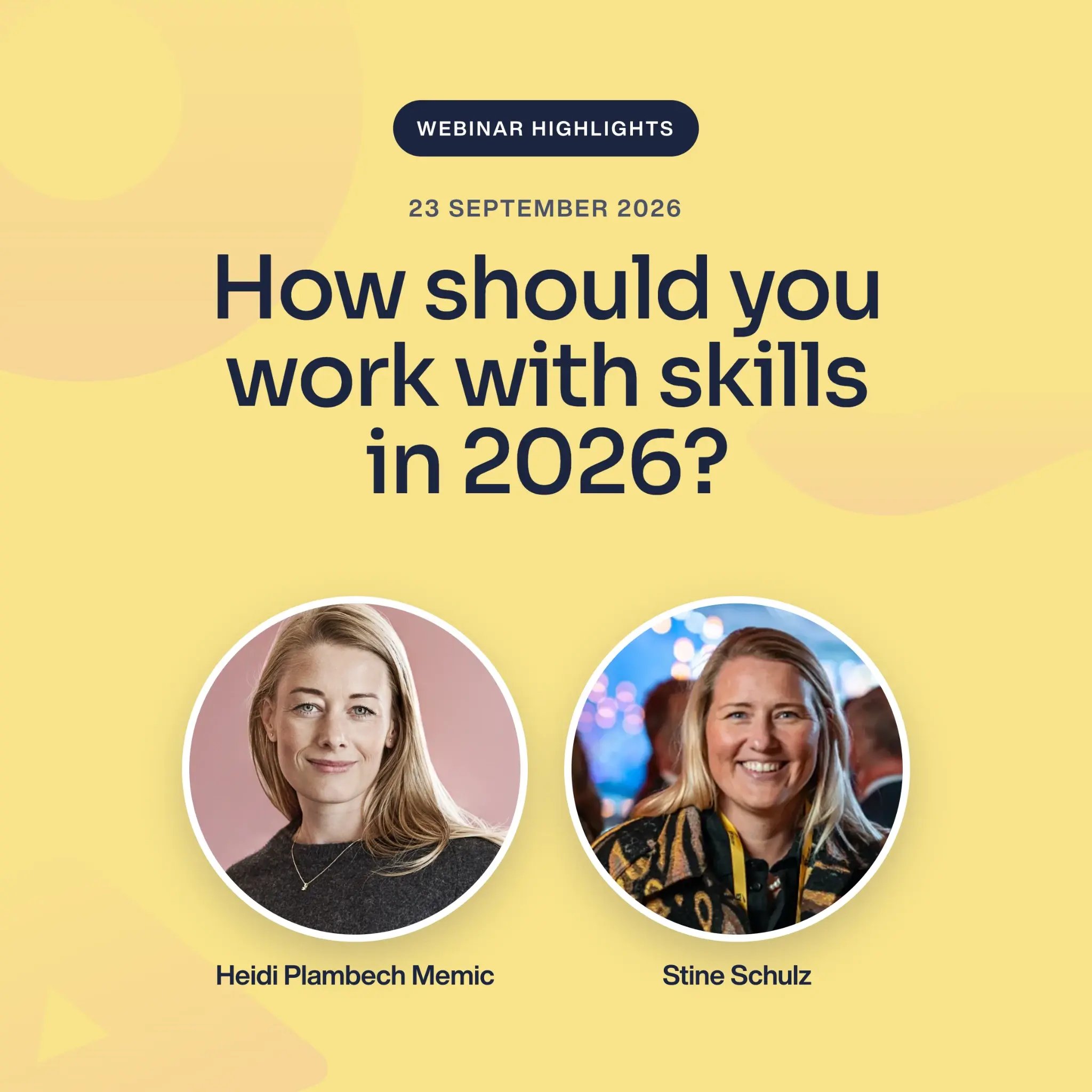
For more than 10 years, Stine Schulz and Heidi Plambech have worked together from opposite sides of the table, as CEO and Founder of Learningbank and HR leader in large frontline organizations.
Along the way, they have seen learning evolve, tested new approaches to skills and navigated major changes in how businesses operate.
In this webinar, they look back at that journey and share their biggest lessons on learning, skills, capability and connecting people development to business performance.
Watch the webinar highlights here
Here are 5 most important highlights from the webinar that Stine and Heidi emphasize as important for any business today working with learning, skills and capability.
1. Start with the business
HR and L&D should start with the outcome the organisation needs to create.
Learning and skills initiatives shouldn't start with HR. They should start with what the business is trying to achieve. From there, the question becomes: what must our people be capable of to make it happen?
2. Learning is not the goal
Engagement and great learning experiences matter, but they are means to an end.
Great learning experiences matter, but completing learning isn't the same as becoming capable. The real measure is what people can actually do differently afterwards and whether it improves performance.
3. Move from skills to capability
Skills mapping alone doesn't change performance.
Knowing which skills people have is only the beginning. The value comes when those skills can be applied in real situations, helping people perform their roles and the organisation close the gaps that matter.
4. Build capability into everyday operations
Don't create another HR process sitting beside the business.
Capability can't become another HR process disconnected from everyday work. It needs to live where performance happens, involving managers and employees and using the right intervention for the problem.
5. Make workforce readiness continuous
Make workforce readiness continuous
The capabilities a business needs today may not be the ones it needs tomorrow. As roles, priorities and technology change faster, organisations need to continuously understand what's needed next and where the gaps are.
Overall takeaway: From learning to business capability
Over the last 10 years, Stine and Heidi’s biggest learning is that learning itself is not the goal. They started by focusing on making digital learning accessible, engaging and memorable. Over time, the question shifted from “How do we get people to learn?” to “What do people need to be able to do?” and ultimately to “What must our workforce be capable of for the business to succeed?”
The lesson is to start with the business outcome, understand the capabilities required to achieve it, identify the gaps and then decide how to close them. And because the business never stops changing, capability development cannot be static either.
“Digital is not the goal. Learning is not even the goal. The goal is what people are actually able to do afterwards.”
Stine Schulz“People initiatives cannot exist next to the business.”
Heidi Plambech
1. There is only one strategy: The business strategy
HR and L&D should not operate with priorities disconnected from the organisation. Start with what the business needs to achieve and determine what that requires from its people.
“There should only be ONE strategy: the business strategy.”
Stine Schulz
“Start with the movement the business needs, not with the HR activity.”
Heidi Plambech
2. Move from learning to capability
Courses, completions and engagement matter, but they are means rather than outcomes. The more useful question is whether people can actually perform what their roles require.
“The question moved from: What should people learn? To: What do people need to be able to do?”
Stine Schulz
“My ultimate goal was always business performance.”
Heidi Plambech
3. Start with the capabilities that actually matter
Don't begin by mapping hundreds of skills. Identify the roles and capabilities most important to the business, understand the current state and focus development where there is a meaningful gap.
“You started small. You focused on the capabilities the business actually needed.”
Stine Schulz
“We started asking what each role actually needed to be able to do to succeed.”
Heidi Plambech
4. Make skills actionable, not another HR framework
Skills mapping has existed for decades. The opportunity is to move it out of spreadsheets and disconnected systems and make capability information useful to employees, managers, HR and the business.
“The opportunity today is to make it dynamic and actionable.”
Stine Schulz
“A skills framework has no value simply because it exists.”
Heidi Plambech
5. Build with the business
Capability development has to reflect what actually happens in operations. Managers and employees closest to the work need to influence what gets developed and how.
“You did not arrive saying: Here is the HR programme. You went out into the business.”
Stine Schulz
“You cannot understand what an organisation needs from behind a desk.”
Heidi Plambech
6. Learning isn't always the answer
Once the gap is understood, choose the intervention that can actually change performance. Sometimes that's learning. Sometimes it's coaching, leadership, technology, practice or process.
“We became more critical about what learning should solve.”
Stine Schulz
“Only then decide the intervention: learning, practice, coaching, leadership, technology, process, or something else entirely.”
Heidi Plambech
7. Design for change, not permanence
COVID, organisational transformations and rebrands demonstrated how quickly carefully constructed learning can become outdated. Capability development needs to adapt with the business.
“Change is the only constant.”
Stine Schulz
“The format became less important. The desired change became more important.”
Heidi Plambech
8. Capability development must become continuous
Annual skills mapping is increasingly incompatible with businesses where roles, priorities and operating models continually change. Organisations need to understand what they require now and what they'll require next.
“It is continuously understanding what the organisation needs to be capable of next, and closing the gap.”
Stine Schulz
“We cannot wait for annual skills mapping to discover that the need has moved.”
Heidi Plambech
9. AI makes this shift more urgent
AI makes content easier to create while simultaneously changing the work itself. The future challenge isn't producing enough learning. It's identifying emerging capability requirements quickly enough.
“The challenge won’t be a lack of content. It will be knowing what people need to be able to do in a reality that keeps moving.”
Stine Schulz
“Technology alone won’t create the transformation. Your people will.”
Heidi Plambech