
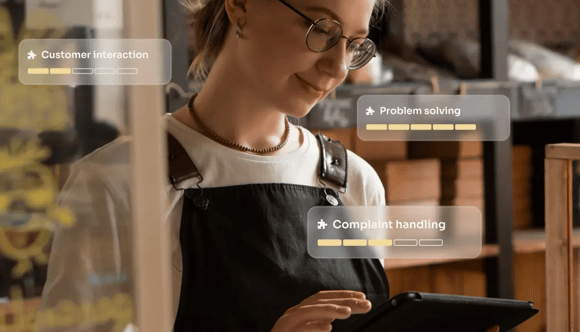
Most companies think they have a hiring problem. They have a skills problem, and it is quietly setting the pace of everything else in the business.
The numbers back this up. The World Economic Forum found that 63 percent of employers now see the skills gap as the single biggest barrier to transforming their business. McKinsey's research across Europe tells a similar story: 90 percent of leaders say building workforce capability is urgent, but only 5 percent believe their organisation is actually equipped to do it.
That gap between urgency and readiness is where performance quietly leaks away.
It rarely arrives as one dramatic failure. More often, it shows up in the everyday moments organisations learn to tolerate:
-
a new hire who takes three months longer than expected to reach full productivity,
-
a store that consistently underperforms the one twenty minutes away despite selling the same products with people in the same roles,
-
or a production line that slows down every time an experienced operator is away, because no one else has been properly prepared to step in.
None of this feels like a crisis in the moment, but over time it adds up to one.
The gap is widening, not closing
This is not a problem that fixes itself over time. The WEF projects that 39 percent of core workforce skills will be transformed or made obsolete by 2030. Cedefop's most recent forecasting puts concrete numbers on this across European sectors, from manufacturing to healthcare to logistics. New technology, new compliance requirements, and new customer expectations are changing what "good at your job" means faster than most training programmes can keep up.
Meanwhile, the traditional response, sending people on a course once a year and hoping it sticks, was never built for this pace of change. It was built for a world in the past where a skill you learned in year one was still relevant in year five.
Why this hits frontline and mixed workforces hardest
Organisations with large frontline or deskless populations feel this earliest and most acutely. These are the employees closest to the customer, the product, and the compliance risk, and they are usually the ones with the least structured access to development, and where skills gets passed down informally, unevenly, and often incorrectly.
-
A retail associate learns the register in week one and is expected to improvise everything else.
-
A production operator learns the machine from whoever happens to be on shift that day.
The cost of that informality is not abstract. Recent workforce research shows that nearly a third of employers lose the equivalent of a full working day per employee simply compensating for skills shortfalls. In practice, that means time lost to double-checking work, repeating processes, and covering for people who were never properly prepared in the first place. This is why skills management matters more for frontline and mixed workforces.
Closing the gap means connecting skills to performance, not just training
Training completions were never the goal. Readiness was always the goal, and readiness only happens when learning is tied directly to what a person actually needs to do their job well, tracked in a way managers can see and act on, and updated as the work itself changes.
This is the core idea behind workforce enablement. Not another course library. A system that connects what people know, what they can do, and how the business is actually performing, so the gap between "trained" and "ready" stops being invisible.
The organisations closing the skills gap fastest are not the ones buying more content. They are the ones building visibility into what their workforce can actually do, right now, at every location, and using that visibility to close gaps to increase workforce performance.
If you want to learn more about skills, and how to improve it in your organization, you can read more about soft skills for leaders, how to keep you organization successful with skills development, dive into what skills management is in 2026, or how skills visibility is fundamental to your workforce performance.
Build the right workforce with the right competencies at the right time.
With Learningbank you can build the right capabilities across your workforce, so employees, managers, and the business can grow in the same direction.

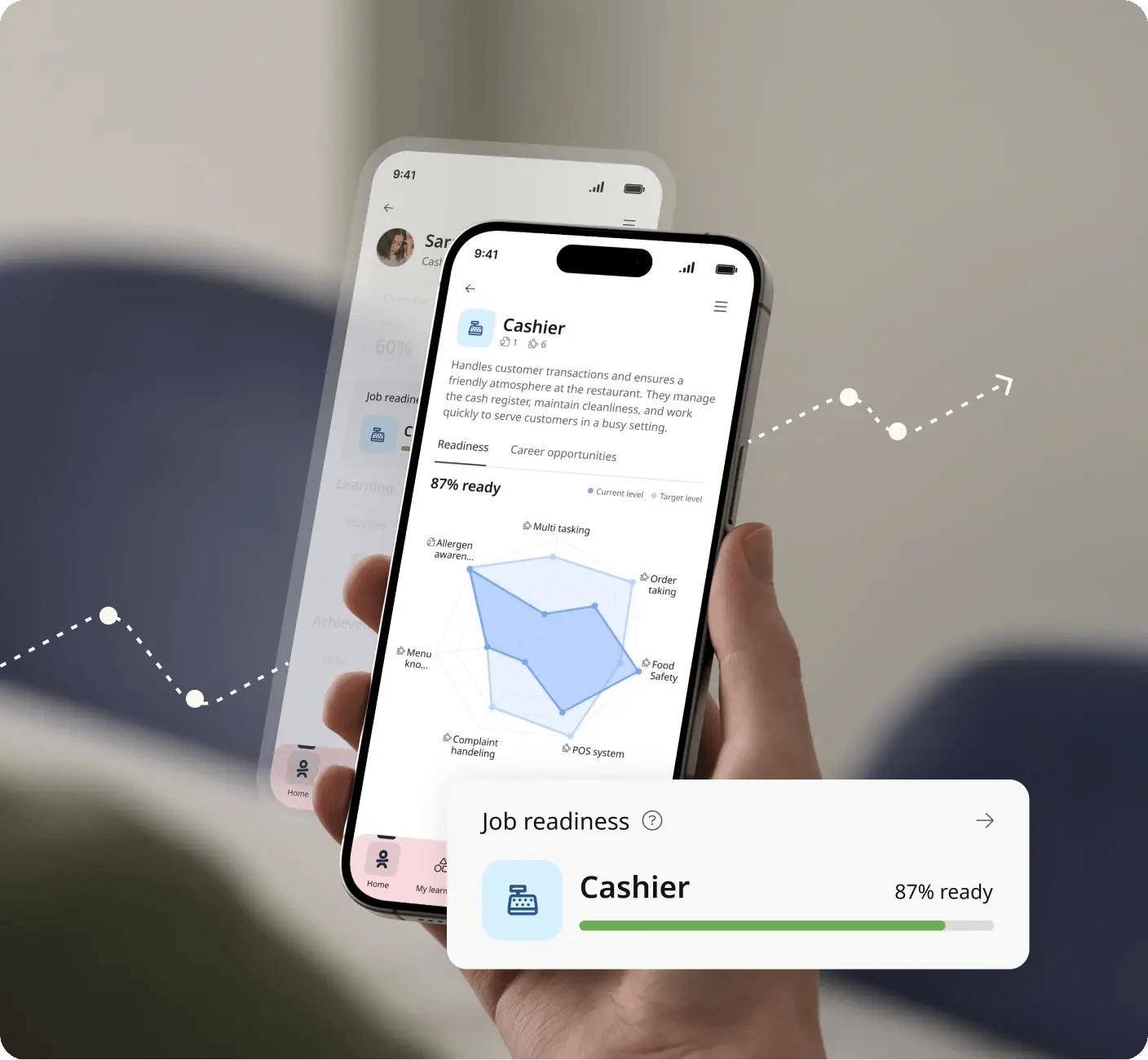 Image: With Skills in Learningbank's Workforce Enablement Platform you get full visibility of your workforce readiness.