

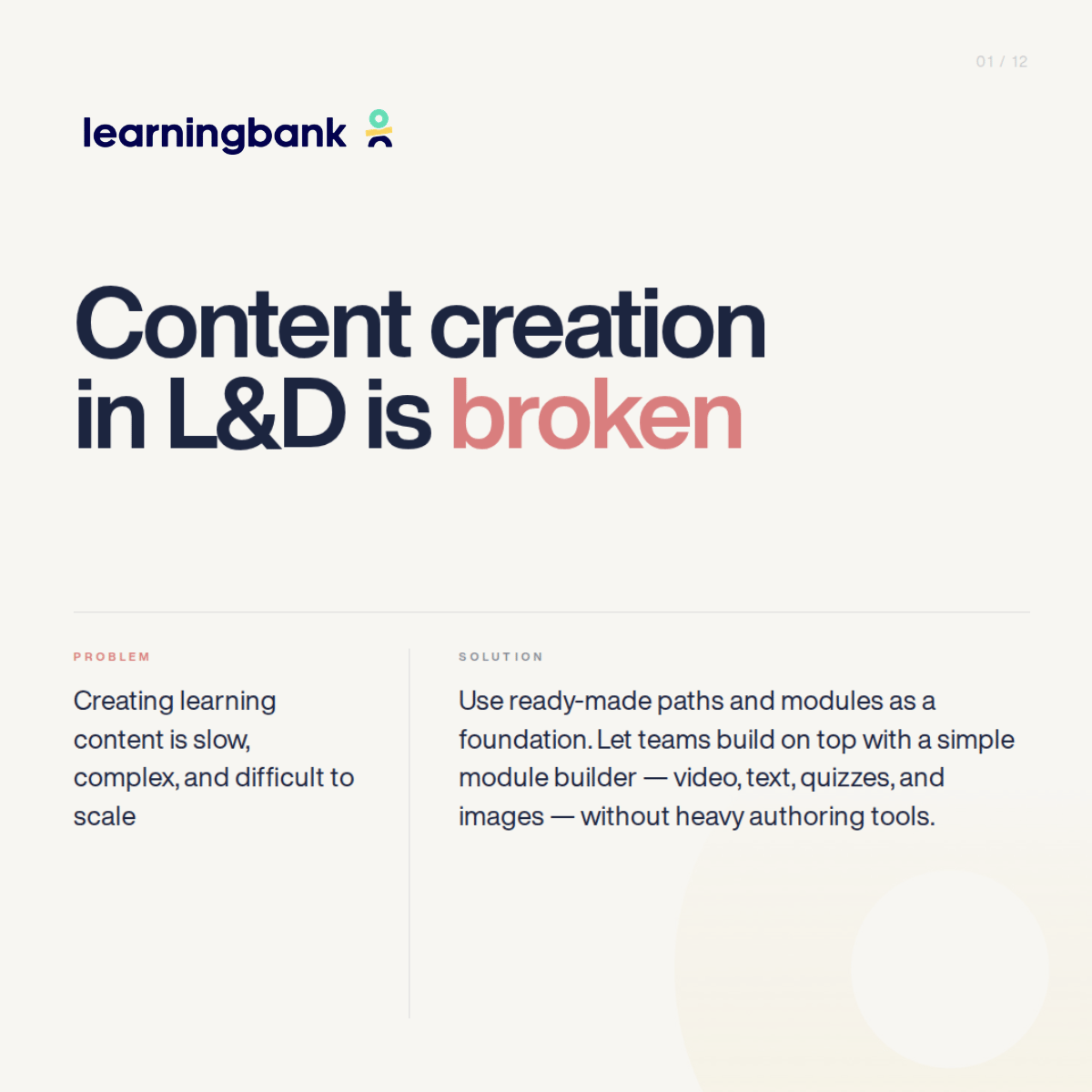
Content creation is where most learning strategies break down. Not because companies lack ambition. But because creating and maintaining learning content is harder than expected.
Many organizations invest in platforms, tools, and programs. Yet they still struggle to deliver relevant learning at scale. The reason is simple. Content is the engine behind everything. And that engine is often slow, fragmented, and difficult to manage.
The hidden problem behind every learning strategy
Most companies believe their challenge is engagement, adoption, or completion rates. In reality, the issue starts much earlier.
Content creation is slow. It requires coordination between L&D, subject matter experts, managers, and often external vendors. Courses take weeks or months to produce. By the time they are launched, parts of the content are already outdated.
A common example. A company needs to roll out new compliance training. L&D starts building a full course from scratch. SMEs are involved late. Feedback loops delay progress. By the time the course is ready, internal processes have already shifted. Employees end up learning something that no longer reflects reality.
According to Brandon Hall Group, 49% of organizations say creating relevant content quickly is one of their biggest learning challenges. That delay creates a gap between what employees are taught and what they actually need to do.
What we see in the field
When you look at real conversations with companies, the same patterns show up again and again.
-
Content creation is too slow for the pace of operations. Frontline employees often get training weeks after launch, so managers and colleagues fill the gap manually.
-
Too much is built from scratch. Teams rebuild training even though content already exists. The problem is not lack of content, but lack of reuse.
-
Content quickly becomes outdated and hard to fix. Even small process changes require rebuilding whole courses, so updates are delayed and employees learn yesterday’s reality.
-
Learning is too far from real work. Content is created as static PDFs or long video series. It does not reflect real situations. After training, employees still need to ask how to handle edge cases.
-
The same content is pushed to everyone. Warehouse staff, store staff, office employees, and managers receive identical courses. The result is generic learning that fits no one.
-
There is no real content operation. Work stays project based instead of continuously creating, updating, and reusing content across the business.
The organizations that break this pattern do something different. They work with modular content, involve experts directly, centralize everything, and continuously improve instead of rebuilding from scratch.
Too much effort. Too little output
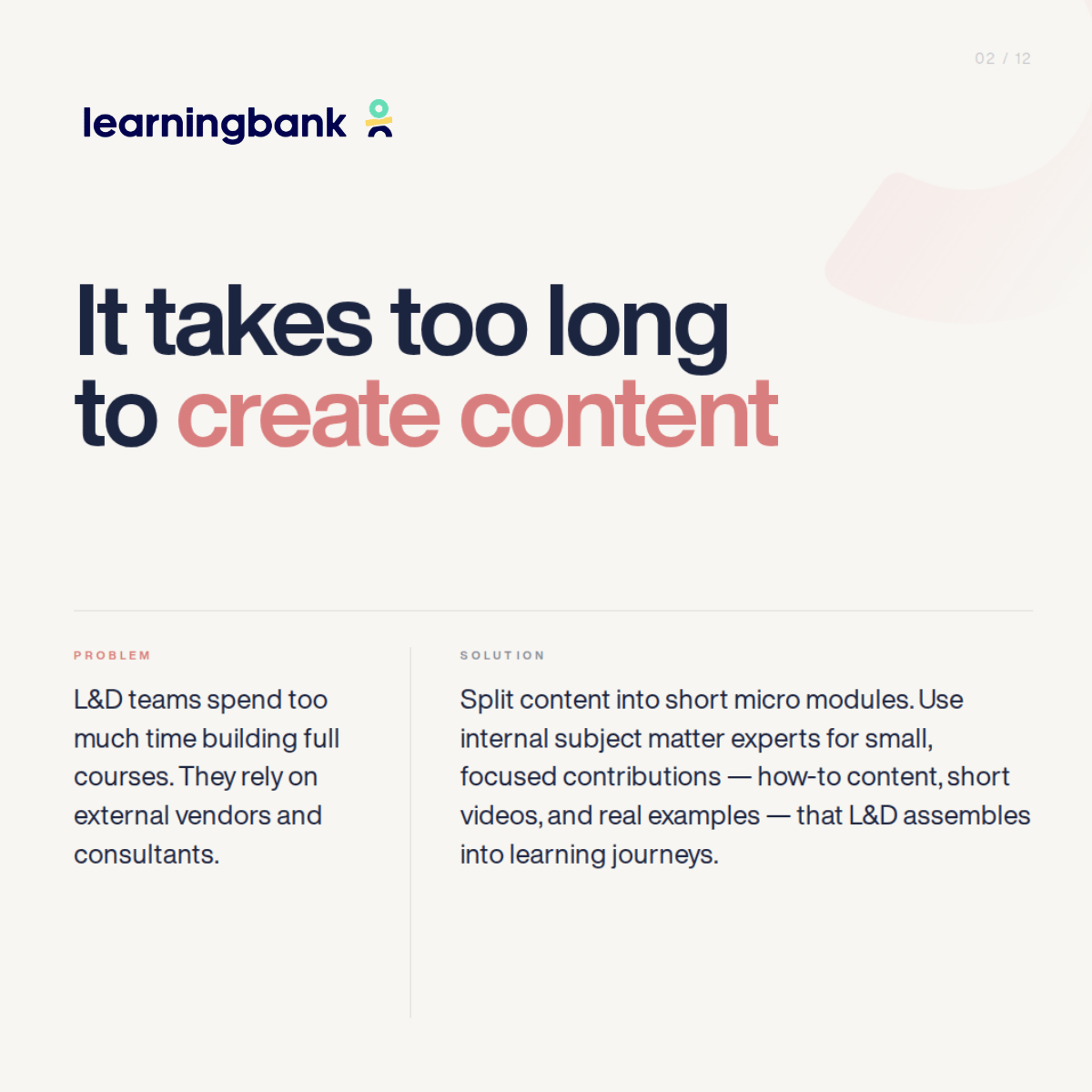
Creating content from scratch is one of the biggest inefficiencies in learning & development.
L&D teams spend significant time building full courses. Scripts are written. Videos are produced. Learning paths are structured. Often, external vendors are involved, which adds cost and slows everything down.
A typical situation. A team builds onboarding for new hires. Instead of reusing existing materials, they start over. At the same time, they already have content available. Videos, documents, and internal guides. But these assets are locked in formats that are difficult to reuse.
Research from ATD shows that organizations spend over 30 hours developing a single hour of e-learning content. That level of effort makes it impossible to keep up with business change.
The result is simple. Content production cannot match the pace of operations.
Content becomes outdated faster than it is created
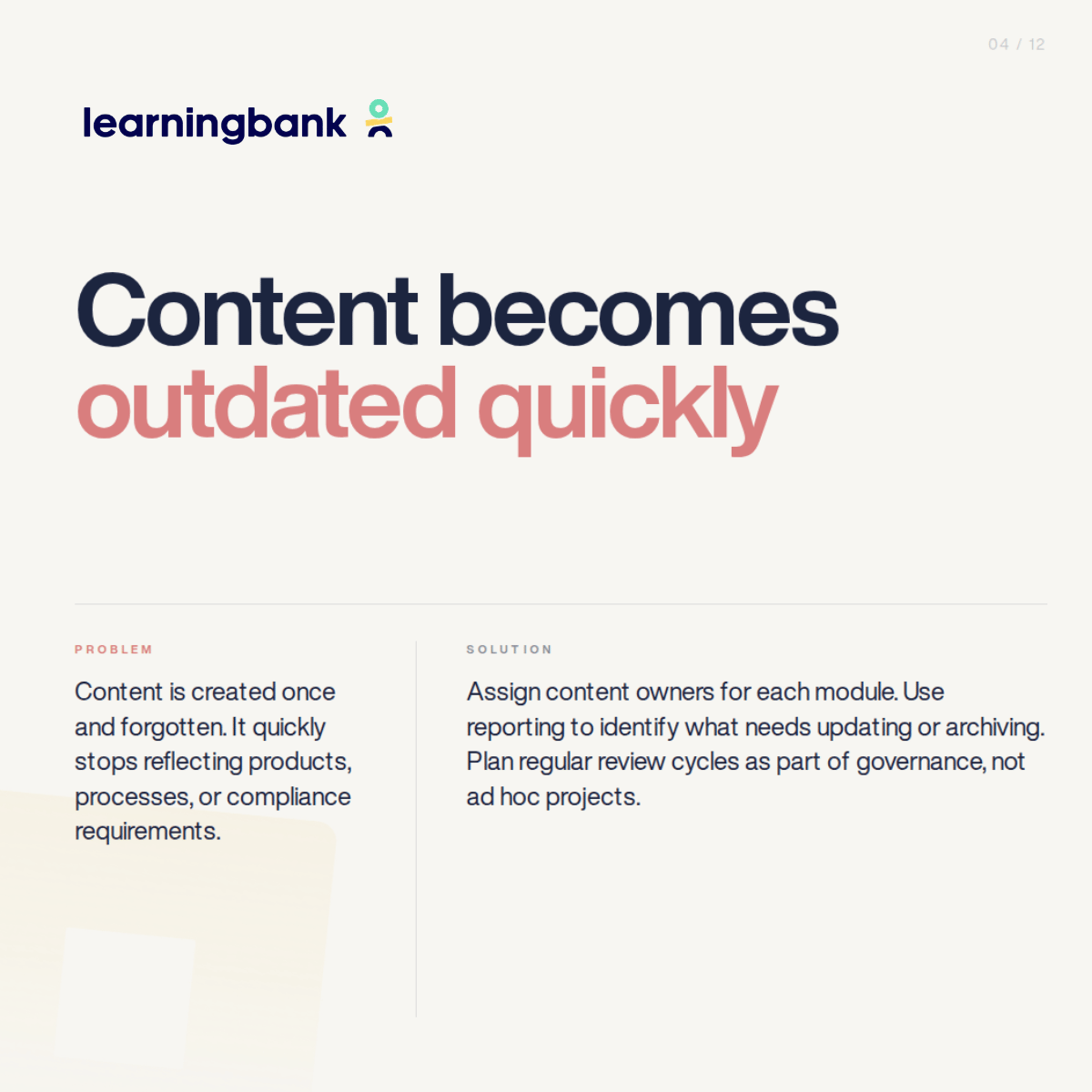
Even when content is delivered, it does not stay relevant for long. Content needs to be updated continuously, not rebuilt occasionally.
Processes change. Systems evolve. Products are updated. Regulations shift. Yet updating content is often as complex as creating it in the first place.
You see this in organizations relying on SCORM or long-form courses. A small update requires rebuilding and redistributing the entire course. So updates are delayed. Or skipped.
Content is disconnected from real work
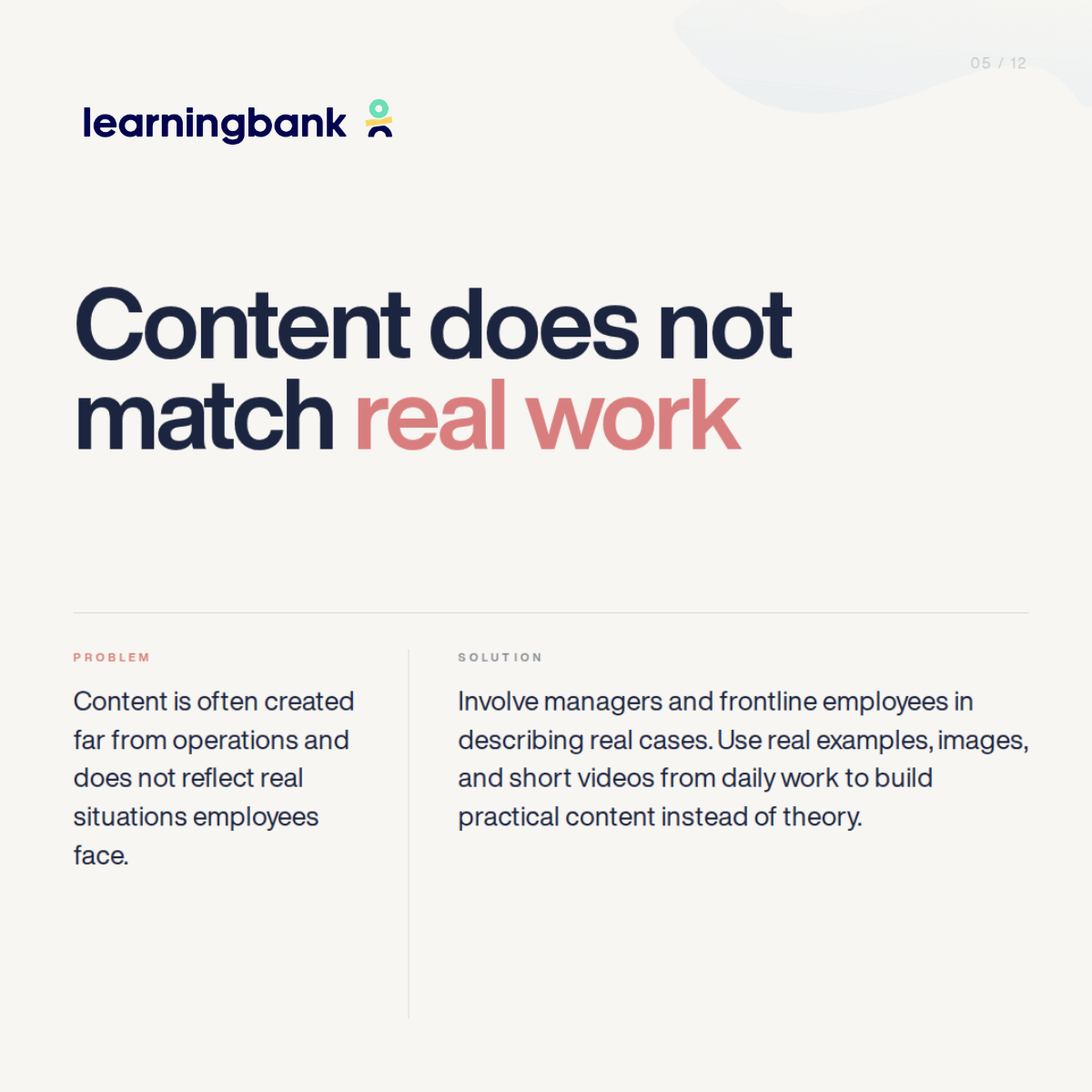 Another core issue is where content is created.
Most learning content is designed away from daily operations. It reflects how work should happen, not how it actually happens.
A familiar example. Training explains ideal processes. But employees face real situations with exceptions and complexity. Those scenarios are missing.
So even after completing training, employees still rely on colleagues or managers to solve real problems.
Learning happens. But performance does not improve.
One size fits all does not work
Many organizations still push the same content to everyone.
Different roles. Different contexts. Same courses.
A typical case. Frontline employees and office workers receive identical training. The content becomes too generic. It does not reflect real tasks or responsibilities.
LinkedIn Learning shows that employees engage more when content is directly tied to their role. Relevance drives engagement. Not volume.
The real bottleneck is content operations
 When you step back, the pattern is clear.
The problem is not learning. It is how content is created and managed.
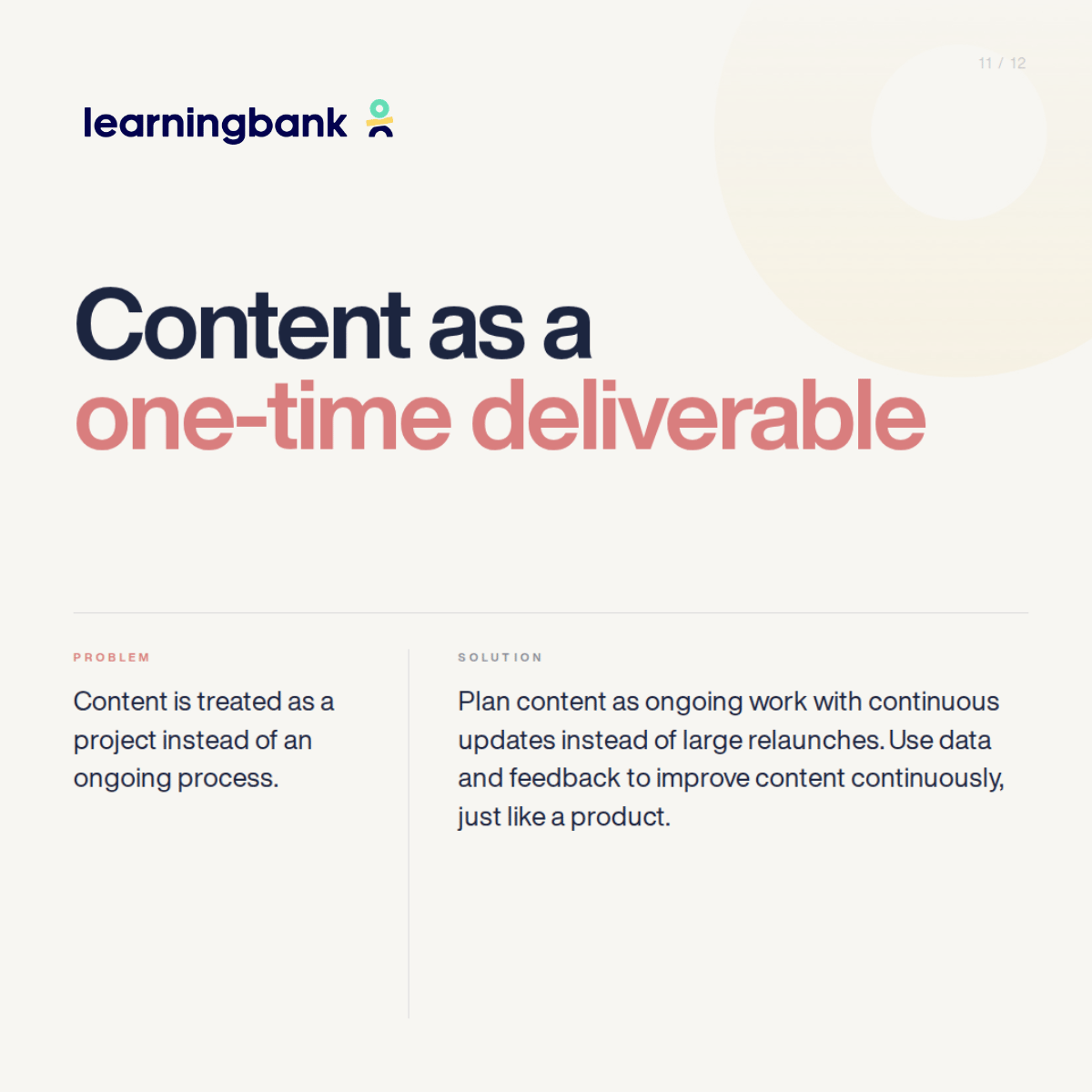
Most organizations treat content as a one-time deliverable. Build it. Launch it. Move on. But effective organizations treat content as an ongoing process.
They break content into smaller modules. They let subject matter experts contribute short, practical inputs. They reuse content across onboarding, compliance, and development.
For example, a safety procedure is created once. It is then reused across multiple learning journeys. No duplication. No rebuild.
This approach reduces effort and increases relevance at the same time.
From content creation to workforce enablement
This is where the shift happens.
Traditional learning delivers content. Workforce enablement makes content usable in real work.
That means content must be accessible in the moment. Easy to update. Built from real scenarios. Continuously improved.
Instead of long courses, employees access short modules, quick answers, and searchable knowledge during work. Learning becomes part of the workflow.
When that happens, content stops being a bottleneck. It becomes a driver of performance.
The bottom line
Content is not just part of learning. It is the foundation.If content creation is slow, complex, and disconnected, everything else will struggle. Engagement drops. Performance stays flat.
But when content becomes continuous, modular, and close to real work, the impact changes. Learning becomes faster. More relevant. More useful.
And most importantly, it starts to drive real performance.