

Creating a learning culture is not about launching more training. It is about making learning part of how work gets done every day. For leaders in mixed workforces, this is especially critical. When teams are split between frontline and office roles, learning often becomes inconsistent, disconnected, and hard to scale.
The result is familiar. Some employees receive structured development while others rely on informal knowledge. Performance varies. Execution becomes inconsistent. And leaders lack visibility into what is actually happening on the ground.
A culture of continuous learning solves this. Not by adding more courses. But by changing how learning is created, shared, and applied across the organization.
Start with performance, not training
Many organizations begin with content. They build courses, assign learning, and track completion. But completion does not equal capability.
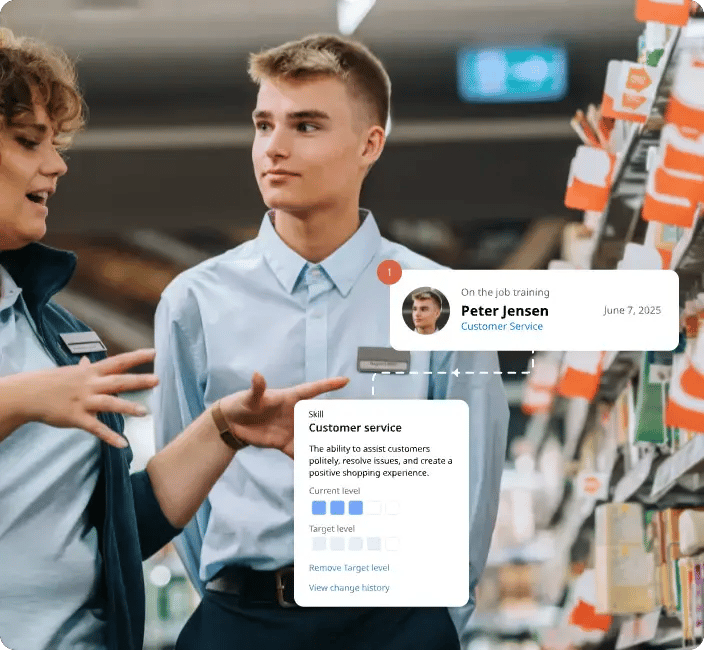
Leaders who succeed start with a different question. What should people be able to do in their role.
Examples from real mixed workforce companies
A national service company moved away from generic onboarding and defined what “ready” looks like for each role. Handling safety procedures, operating machines, and serving customers within clear standards. Learning was then built around those tasks using short modules and on the job verification.
Fact: Only 12% of employees apply new skills learned in training to their job (Harvard Business Review)
This shift makes learning practical and directly tied to performance.
Make learning part of daily work
In mixed workforces, time is limited. Employees learn between tasks, not in classrooms.
A common mistake is pushing long courses that require dedicated time.
Examples from real mixed workforce companies
A fast growing restaurant chain replaced classroom onboarding with short mobile learning paths completed during first shifts. New hires take 5 to 10 minute modules on safety, hygiene, and service directly on their phone. Managers can immediately see who is ready for which tasks.
A logistics company uses short safety refreshers before each shift. Drivers review scenarios and start work with clear expectations.
Fact: Employees are 3 times more likely to retain learning when applied immediately (ATD)
Learning becomes something employees use in the moment.
Enable managers to drive learning
Managers are key to making learning work. But many lack visibility and tools.
Examples from real mixed workforce companies
A retail organization replaced manual tracking in Excel with a simple overview of onboarding, compliance, and skill gaps. Managers can assign targeted learning and follow up directly on the job.
In logistics, supervisors gained visibility into complex skill combinations such as certifications and routes. This made planning based on real capability instead of assumptions.
Fact: 70% of employee engagement is driven by managers (Gallup)
Learning becomes part of daily leadership.
Create content close to the business
Content created far from operations quickly becomes irrelevant.
Examples from real mixed workforce companies
A hospitality group moved from long videos and PDFs to short modules created by store managers. Real customer situations, common mistakes, and best practices were turned into short learning pieces reused across locations.
In manufacturing, experienced operators helped create short safety scenarios used directly on the shop floor.
Fact: Employee generated learning can increase engagement by up to 50% (Deloitte)
Content becomes more relevant and faster to update.
Break down silos between teams
Mixed workforces often operate in silos between headquarters and frontline.
Examples from real mixed workforce companies
An industrial company introduced new safety procedures and turned them into practical microlearning. Feedback from frontline teams was used to improve both the process and the training.
A multi brand organization created shared core content while allowing local teams to adapt examples and language.
Fact: Only 40% of employees understand how company strategy connects to their role (McKinsey)
Learning becomes a shared system.
Use data to drive continuous improvement
Tracking completion is not enough. Leaders need to understand performance.
Examples from real mixed workforce companies
A company compared safety training results with incident data. Where incidents remained high, they improved content and added more realistic scenarios.
Another organization analyzed where employees dropped off or failed questions. They simplified content and split long modules into smaller parts.
Fact: Data driven learning organizations are 5 times more likely to improve performance (Bersin)
Learning becomes a continuous loop.
Make learning simple and accessible
If learning is hard to access, it will not be used.
Examples from real mixed workforce companies
A retail organization replaced scattered systems with a mobile first platform. Employees access learning directly on their phone in their own language with clear role based paths.
Another organization combined digital modules with workshops and short refreshers. This reduced time away from work and improved retention.
Fact: 80% of the global workforce is deskless, yet most systems are built for office employees (BCG)
Removing friction increases adoption.
The bottom line
A culture of continuous learning is built through everyday actions.
Leaders who succeed tie learning to performance. They bring it into daily work. They empower managers. They involve the business in content creation. And they use data to improve continuously.
In mixed workforces, this creates alignment between frontline and headquarters, between learning and doing, and between training and real performance.
That is when learning stops being an initiative and becomes how the organization works.