

Most learning platforms were never built for the people who actually keep the business running. They were built for admin, tracking completions, and storing courses. Not for performance. And that is exactly why they let frontline teams down.
The LMS problem
Traditional LMS platforms were designed for another era. An era where employees sit at desks, learning happens in scheduled sessions, and training is something you complete, tick off, and forget. Frontline work could not be further from that reality. Employees are on the floor, in stores, warehouses, kitchens, clinics, and production lines. They do not have time to log into a system, search, and scroll. They need answers fast. They need clear guidance in the moment. They need to know what to do right now.
An LMS cannot keep up with that, because it is built to deliver content – not to support daily work. And when work changes constantly, static content will always be one step behind.
Let's talk facts first:
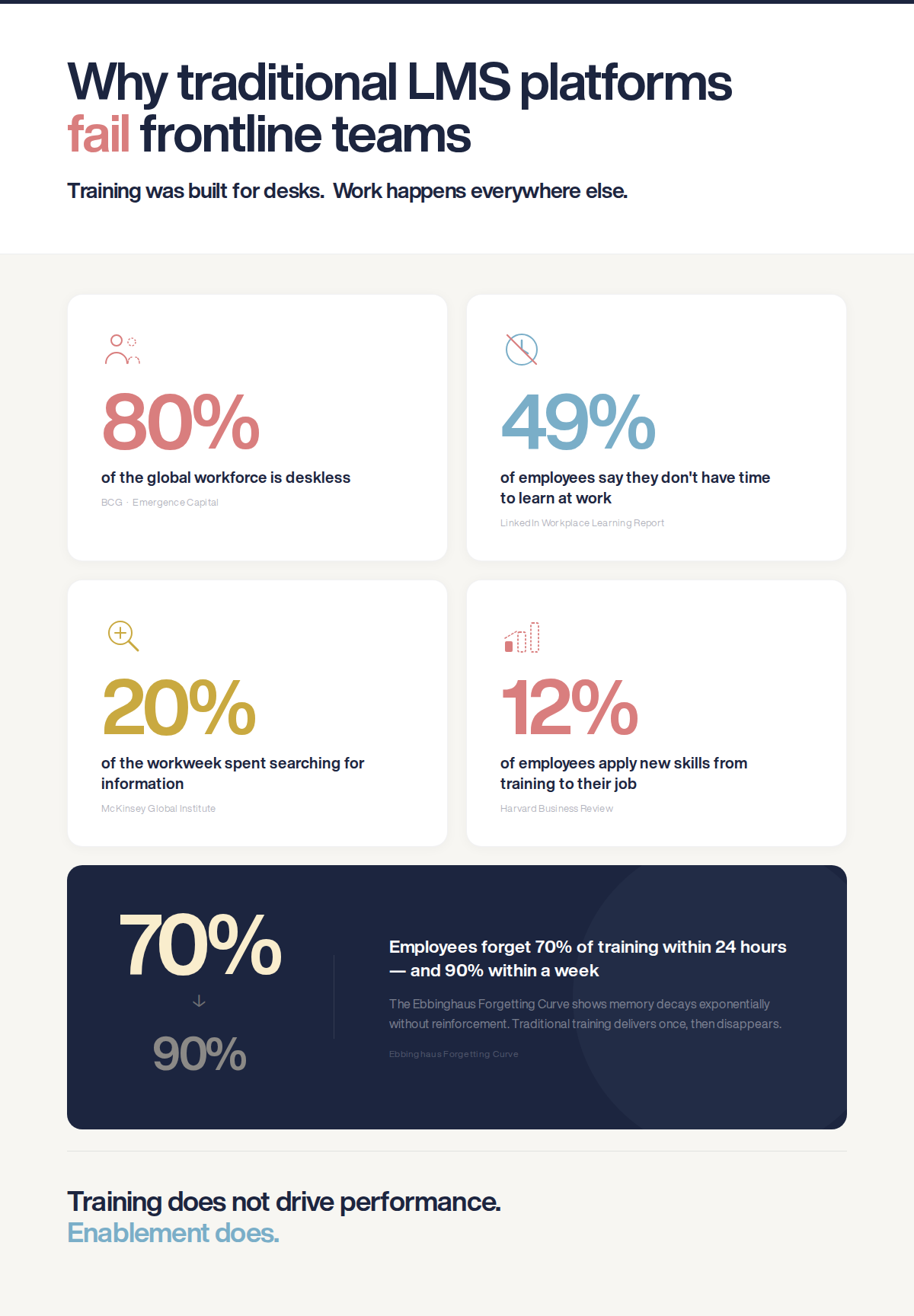
- 80% of the global workforce is deskless (BCG, Emergence Capital)
- 49% of employees say they do not have time to learn at work (LinkedIn Workplace Learning Report)
- Employees forget up to 70% of training within 24 hours and 90% within a week (Ebbinghaus Forgetting Curve)
- Employees spend nearly 20% of their workweek searching for information (McKinsey)
- 83% of workers rely on colleagues to find information (Panopto Workplace Knowledge Report)
- 75% of managers say employees are not fully prepared after training (Gartner)
- Only 12% of employees apply new skills learned in training to their job (Harvard Business Review)
- 72% of businesses say productivity improves when frontline workers are better enabled (Flip / frontline enablement research)
Completion does not equal performance
Most LMS platforms still celebrate completion rates, certificates, and quiz scores as proof of success. It looks nice on a dashboard, but it says very little about what really matters: performance in real life.
You can have 100% completion and still struggle with slow onboarding, inconsistent execution across locations, repeated mistakes, safety incidents, and frustrated managers. Completing a course does not mean an employee can actually do the job.
Frontline performance is not tested in a multiple-choice quiz. It is tested in real situations, under pressure, with customers, patients, and guests. This is exactly where traditional LMS platforms fall short. They stop at knowledge. But your business runs on performance.
Learning is disconnected from daily work
In many organisations, learning lives in one system while work happens everywhere else. Training is stored in the LMS, procedures in shared drives, knowledge in scattered documents, and follow‑up in spreadsheets or emails. Employees are expected to connect all the dots themselves.
That rarely works on a busy shift. When an employee faces a real situation, there is no time to search across systems and folders. They either guess or ask a manager. Both options slow things down, create variability, and increase risk.
This disconnect is one of the main reasons LMS platforms fail frontline teams: learning is simply not where work happens. And if learning is not accessible in the flow of work, it will not change behaviour.
Managers are left out
Frontline performance lives and dies with managers. They coach, follow up, and make sure standards are understood and used – not just once, but every single day. Yet most LMS platforms give managers almost no real support.
They can see who completed which course, but they cannot see who is actually ready to perform. They do not get a clear view of where their team struggles, who needs targeted support, or what to prioritise next. So they guess, chase people for training, or answer the same questions again and again.
This is frustrating for managers and employees – and it blocks performance across the entire operation.
Training is not enough
The issue is not that organisations invest in learning. The issue is how that learning is designed, delivered, and used.
Traditional LMS platforms treat learning as an event. You assign a course, employees complete it, and the system considers the job done. But real work does not happen in events. It happens all the time. On night shifts. In peak seasons. When new processes, systems, or regulations roll out.
Frontline teams need more than one‑off training. They need:
- Clear expectations about roles and required skills
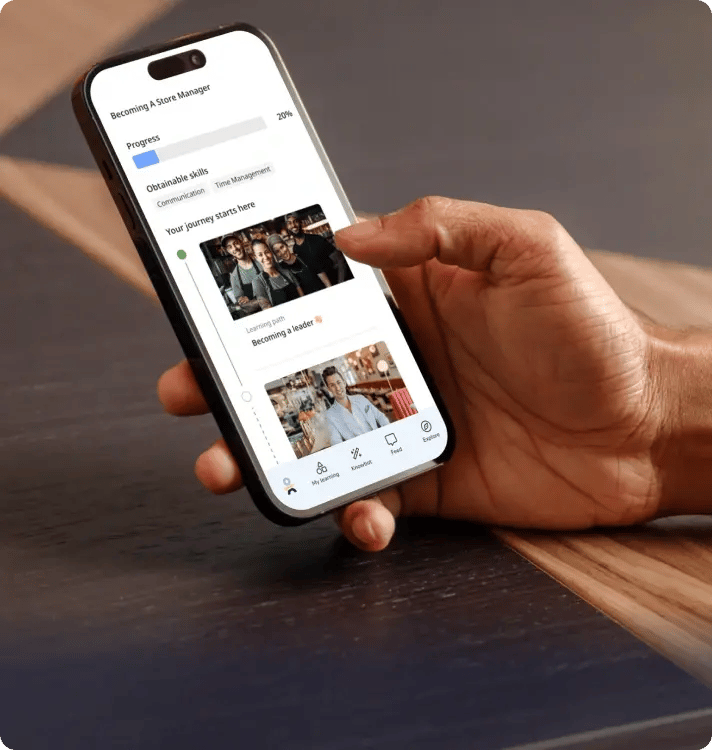
- Access to knowledge in the exact moment of need – on any device
- Practical guidance on how to handle real situations, compliance and edge cases
- Managers who are empowered & enabled to coach based on real performance data
- A learning culture that makes learning part of everyday work, mobile-first, structured, and easy to scale across roles, teams, and locations
This is where Workforce Enablement changes the game: it connects learning directly to performance, so training is not just something people complete, but something they use every day.
What frontline teams actually need
To truly improve performance, organisations need to move beyond the traditional LMS mindset. You need a platform that supports how work actually happens in retail, hospitality, healthcare, logistics, production, and more.
Frontline employees need:
- Short, relevant learning in the flow of work, not hour‑long modules
- Knowledge and instructions that are easy to find in real time, on mobile
- Clear, simple paths that show what to learn next, based on role and location
Managers need:
- Visibility into what their team can actually do, not just what they completed
- A clear overview of gaps, risks, and strengths across sites and roles
- Tools and insights to coach effectively without drowning in admin
This is not about adding more content. It is about making learning truly usable, measurable, and tied to business outcomes.
.jpg?width=1200&height=1200&name=WFE%2011%20Social%20posts%20(Platform%20+%20Culture).jpg)
Image: With Culture in the Workforce Enablement Platform, managers can easily work with development of employees.
From learning platform to Workforce Enablement Platform
This is the shift happening now. Forward‑thinking organisations are moving:
- From courses to skills
- From static content to measurable performance
- From one‑off training to continuous enablement in the flow of work
The business does not need another pile of completed courses. It needs confident employees, faster time‑to‑performance, consistent execution across locations, fewer errors, safer workplaces, and better customer and patient experiences.
Traditional LMS platforms were never built to deliver that. Workforce Enablement Platforms are. They bring together learning, skills, knowledge, manager tools, and compliance in one place – not just to manage training, but to lift performance and resilience across the workforce.
The real question
The question is no longer “How many courses did employees complete?”
The real question is: “Can they do the job – safely, consistently, and to the standard we need?”
If the answer is unclear, the system is not working hard enough for your business. That is why more organisations are rethinking the role of the LMS and choosing platforms that connect learning, work, and performance – every single day.